
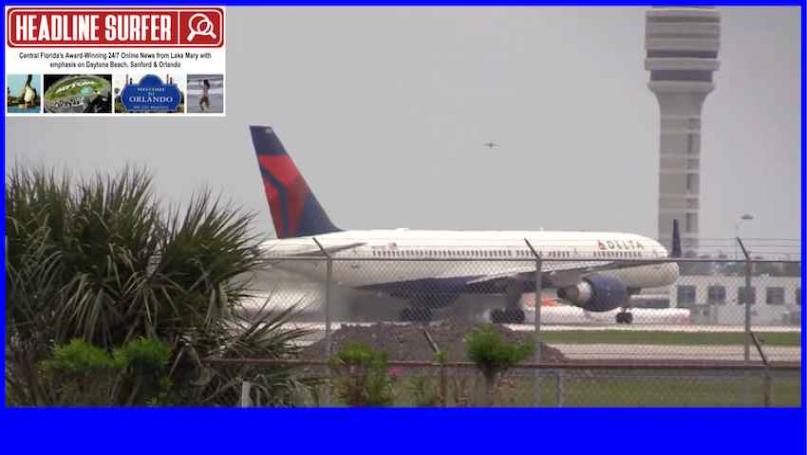
Photo for Headline Surfer / A Delta airliner taxiing on a runway at Orlando International Airport on Thursday, Nov. 6, 2025, in Orlando, Florida.
By HENRY FREDERICK / Headline Surfer
ORLANDO, Fla. -- Orlando International Airport is among 40 high-traffic airports across the US ordered by the Federal Aviation Administration to reduce flights during the federal government shutdown starting today.
Three other major airports in the Sunshine State are impacted as well:
• Tampa International Airport;
• Miami International Airport;
• Fort Lauderdale-Hollywood International Airport.
A 4 percent reduction in operations will take effect today, increasing to 6 percent by Tuesday, November 11, 8 percent by Thursday, November 13, and 10 percent a week from today, on Friday, November 14.
Since the shutdown began, controllers have been working without pay, and staffing triggers at air traffic facilities across the country have been escalating. This has resulted in increased reports of strain on the system from both pilots and air traffic controllers. This past weekend, there were 2,740 delays at various airports.
U.S. Transportation Secretary Sean P. Duffy and Federal Aviation Administration Administrator Bryan Bedford outlined in a press release the "proactive actions the FAA will take to maintain the highest standards of safety in the national airspace system."
This includes achieving a temporary 10 percent reduction in flights overall at 40 high-traffic airports across the country.
The 40 affected high impact airports include:
ANC – Ted Stevens Anchorage International Airport;
ATL – Hartsfield-Jackson Atlanta International Airport;
BOS – Boston Logan International Airport;
BWI – Baltimore/Washington International Airport;
CLT – Charlotte Douglas International Airport;
CVG – Cincinnati/Northern Kentucky International Airport;
DAL – Dallas Love Field;
DCA – Ronald Reagan Washington National Airport;
DEN – Denver International Airport ;
DFW – Dallas/Fort Worth International Airport;
DTW – Detroit Metropolitan Wayne County Airport;
EWR – Newark Liberty International Airport;
FLL – Fort Lauderdale/Hollywood International Airport;
HNL – Honolulu International Airport;
HOU – William P. Hobby Airport;
IAD – Washington Dulles International Airport;
IAH – George Bush Houston Intercontinental Airport;
IND – Indianapolis International Airport;
JFK – New York John F. Kennedy International Airport;
LAS – Las Vegas McCarran International Airport;
LAX – Los Angeles International Airport;
LGA – New York LaGuardia Airport;
MCO – Orlando International Airport;
MDW – Chicago Midway International Airport;
MEM – Memphis International Airport;
MIA – Miami International Airport;
MSP – Minneapolis–St. Paul International Airport;
OAK – Oakland International Airport;
ONT – Ontario International Airport;
ORD – Chicago O’Hare International Airport;
PDX – Portland International Airport;
PHL – Philadelphia International Airport;
PHX – Phoenix Sky Harbor International Airport;
SAN – San Diego International Airport;
SDF – Louisville International Airport;
SEA – Seattle–Tacoma International Airport;
SFO – San Francisco International Airport;
SLC – Salt Lake City International Airport;
TEB – Teterboro Airport;
TPA – Tampa International Airport.
The FAA will also:
- Prohibit some visual flight rule approaches (VFR) at facilities with staffing triggers.
- Commercial space launches and reentries will only be permitted between 10:00 p.m. and 6:00 a.m. local time.
- Prohibit parachute operations and photo missions near facilities with a staffing trigger.
These actions were directly informed by the FAA’s review of aviation safety data, including voluntary, confidential safety reports that pilots and air traffic controllers file. The data indicates increased stress on the system, which increases risk.
Additional Information:
Airlines will be required to issue full refunds. They will not be required to cover secondary costs. This is the standard procedure when a delay or cancellation is not the carrier's fault.
The order does not require a reduction in international flights. Carriers may use their own discretion to decide which flights are canceled to reach the order’s goal.
Decisions to increase or decrease these flight reductions will be informed by safety data.
 About the Byline Writer: